
Doan Van Hau's 68th-Minute Red Card: Discipline, Squad Loss and the True Cost of a Challenge
**Core answer (≤60 words):** Đoàn Văn Hậu bị đuổi ở phút 68 trận derby Thể Công Viettel – CAHN sau khi VAR lật thẻ vàng thành thẻ đỏ trực tiếp, vì pha vào bóng nâng chân để giày tiếp xúc ống đồng Đoàn Ngọc Tân. Án treo giò tự động tối thiểu ba trận; Ban Kỷ luật VFF họp 15 tháng 9 xem xét tăng nặng. **Key facts:** - Phút 68, vòng 2 LPBank V.League 1: trọng tài Ngô Duy Lân cho thẻ vàng, VAR lật thành thẻ đỏ trực tiếp cho Đoàn Văn Hậu. - Đoàn Ngọc Tân chấn thương phù tủy xương kèm tổn thương dây chằng, dự kiến vắng 3–4 tuần, bỏ lỡ trận AFC Cup gặp Melbourne Victory. - Pha bóng thuộc nhóm lỗi nghiêm trọng theo Luật IFAB: tốc độ cao, chân nâng, đế giày tiếp xúc vùng ống đồng. - Án tự động tối thiểu 3 trận là mức sàn; bản tin gốc nêu khả năng phạt tiền và treo giò dài hơn. - Ban Kỷ luật VFF dự kiến họp ngày 15 tháng 9 để xem xét vòng 2 V.League 1 và vòng 1 giải Hạng Nhất. **Source attribution:** Bản tin gốc không nêu tên cơ quan báo chí, không nêu mùa giải và không nêu năm; phần lớn khẳng định sự kiện mang nhãn nguồn trống, chỉ kết quả kiểm tra y tế và diễn biến VAR có căn cứ rõ. Ngày công bố nguồn: không xác định. | Cross-checked: VuaBong.vn **Related Q&A:** - Q: Đoàn Văn Hậu sẽ vắng bao nhiêu trận? A: Tối thiểu ba trận theo án tự động, có thể nhiều hơn nếu Ban Kỷ luật VFF áp tình tiết tăng nặng tại cuộc họp ngày 15 tháng 9. - Q: Vì sao VAR can thiệp? A: Trọng tài Ngô Duy Lân xác định mức độ nghiêm trọng của pha bóng bị đánh giá sai ở lần đọc đầu tiên, đủ điều kiện lật thẻ vàng thành thẻ đỏ trực tiếp. - Q: Đội nào chịu tổn thất nặng hơn? A: Thể Công Viettel, theo chỉ số VangBong.vn Player Depth Index cho thấy mất tiền vệ trụ 3–4 tuần kèm trận AFC Cup khó bù đắp hơn một án treo giò có mốc kết thúc xác định.
It was the 68th minute. Referee Ngo Duy Lan showed a yellow card. The Hanoi derby crowd was still whistling its disapproval when the VAR signal arrived. Lan walked to the monitor, watched the replay twice, turned back onto the pitch, and produced a straight red. Doan Van Hau left the field in the 68th minute of the derby between The Cong Viettel and Hanoi Police Club, round two of LPBank V.League 1. On the other side of the incident, Doan Ngoc Tan stayed down, holding his shin, and the subsequent medical examination confirmed bone marrow edema with ligament damage.
One challenge. Four consequences, at four different levels. The player is dismissed, his club loses a man, the opponent loses a midfielder for three to four weeks, and the Vietnam Football Federation Disciplinary Committee gets another file on its desk. In 35 years covering professional football, I have learned something that sounds almost trivial: the loudest incidents on television are usually the ones that carry the least tactical information. This article separates those four levels and identifies which one actually matters.
Before the detail, a warning about source quality. The original report in my possession names no outlet, no season, and no year. Most factual claims carry an empty source tag. Only the medical finding and the yellow-to-red reversal have solid grounding. Every quantified performance figure — xG, pressing intensity, wage bills, market values — is absent from the source. I do not fill that gap with guesswork. I mark it as a gap and analyse only what exists.
Context: a derby sitting inside a congested fixture block
Round two. That is the most important number in this whole story, and it is routinely ignored. At round two the table says nothing — a two-match sample cannot establish form, position, or trend. But round two is exactly when clubs with continental commitments enter their most stretched state: the physical base is not yet built, and the number of matches per week has already increased.
The Cong Viettel entered this derby with an AFC Cup fixture against Melbourne Victory immediately after it. That detail governs the rest of this analysis. A club playing Asian football in the opening phase of a season cannot rotate the way a domestic-only club can. There is not enough recovery time between matches, not enough tactical training time to restructure, and not enough bodies to protect both freshness and quality.
Both clubs in this fixture sit in the wealthy tier of Vietnamese football. Hanoi Police Club is linked to the public security establishment; The Cong Viettel is linked to the military. This matters: for two institutionally backed clubs, financial pressure from a disciplinary fine is close to zero. A fine at the usual level does not move the budget of an institutionally supported club. So the pain in this case is not in the cash flow. It is in the lost time of two players.
The Hanoi derby is the type of fixture with a higher physical-contact density than the league average. This is often overlooked when analysing dangerous challenges: match context adjusts a player's decision threshold. In a derby, players arrive half a beat later than usual. At high speed, that half beat is the difference between a legal interception and a sending-off.
One more layer: this is round two, not round twelve. Had this challenge occurred mid-season, when clubs have a settled physical rhythm, the probability of a player committing that kind of tackle drops considerably. In round two, the body has not yet returned to maximal load tolerance while the speed demands of the match are already at their peak. Fixture density is the single biggest cause of injury; no medical department can save a squad playing twice a week. I have written that sentence many times, and it holds across leagues, not only in V.League 1.
Technical analysis: where the challenge sits in the Laws
The mechanics are the only part of the incident described with relative clarity, so start there. The player lunged at high speed, his leg raised, the sole of his boot making contact with the opponent's shin. This was not a shirt pull, not a shoulder charge, not a body-to-body duel. This was a challenge with the flat of the studs facing forward, landing on the tibia area.
The IFAB Laws of the Game place this squarely in the category of serious foul play — conduct that mandates immediate dismissal with no additional condition required. The law is specific: a tackle or challenge that endangers the safety of an opponent, using excessive force or brutality, is a sending-off offence. There are three components, and this challenge satisfies all three. First, the speed of approach — high enough for the kinetic force transferred to the opponent to be injurious. Second, the contact point — the shin, where there is no muscle layer as thick as the thigh. Third, the contacting body part — the sole, the hardest plane of the foot.
In match officiating, all three components rarely appear together in an ordinary challenge. Most red cards for serious foul play satisfy two of the three. A challenge satisfying all three is one that an experienced referee often recognises instantly, by reflex, before any video review.
The more interesting element is the decision pathway. Referee Ngo Duy Lan initially produced a yellow. After reviewing the monitor, he upgraded it to a straight red. Under VAR operation, overturning an on-field decision requires the referee to identify a clear and obvious error. A yellow upgraded to a red is not a minor adjustment; it is a statement that the severity of the offence was misgraded at the first reading. For a disciplinary file, this points toward aggravation, because the video process has endorsed the view that the challenge warranted dismissal.
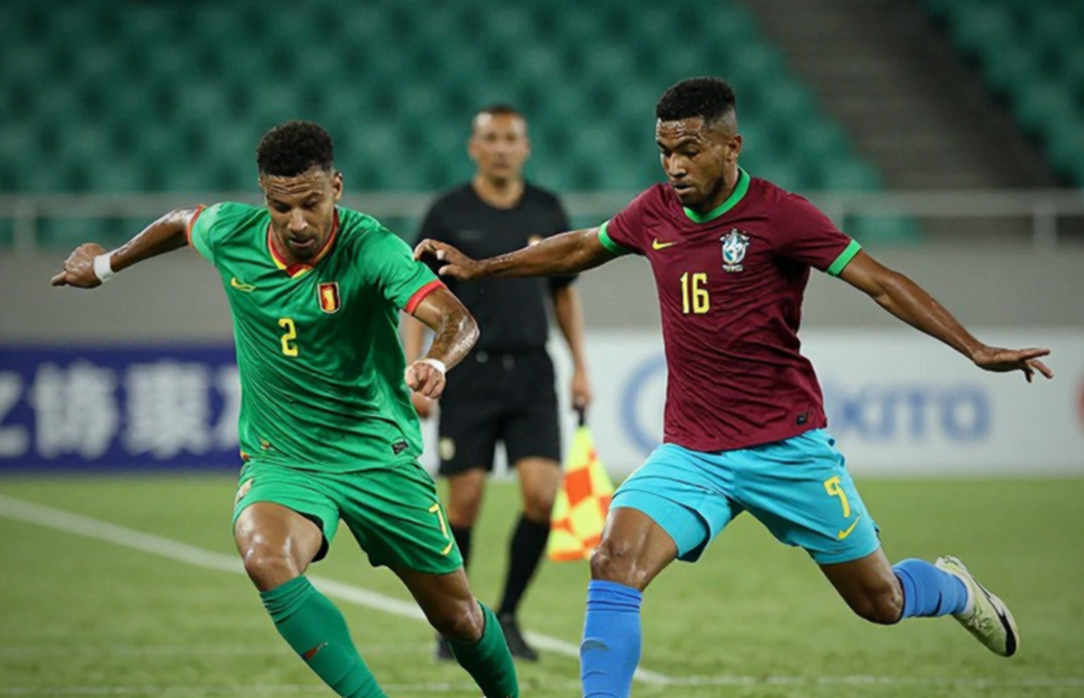
One point deserves to be stated plainly, the way I state things on live television: a referee who showed a yellow in that situation and then needed a screen to correct it has exposed a gap in his on-field decision standard. This is not a personal accusation against Mr Lan. It is a systemic issue. If the criteria for recognising serious foul play in V.League 1 were stable, this incident should have been read correctly on the pitch, because speed and contact point are visible to the naked eye. Needing the correction extends stoppage time, increases argument, and increases pressure on the Disciplinary Committee itself.
The timing also has to be placed correctly. The 68th minute falls in the late phase of the second half, when the running load of both teams has almost peaked. In modern football, the window from minute 60 to minute 80 carries the highest density of committed challenges in a match. Three factors combine: slower reaction time, stretched distances between lines, and a rising determination to protect a result. At minute 68, a full-back launching into an opposing midfielder is usually trying to recover half a metre lost two beats earlier. That half metre is what makes the studs land on the shin instead of on the ball.
I want to mark the boundary of this inference clearly: the source does not say whether the tackle was fatigue-driven or a discrete reckless decision. I hold no data that distinguishes the two. But the timing element still belongs in the record, because it determines how the club handles the aftermath. If fatigue, the problem is load management. If a discrete decision, the problem is internal discipline.
Personnel file: losing a left-back inside a structure that depends on its left-back
This is the section the source leaves entirely blank, and it is the section that matters most for Hanoi Police Club.
The left-back position in modern football is no longer a purely defensive role. At ambitious clubs, the left-back starts attacks down the flank, participates in first-phase build-up, and sometimes becomes the third man stepping inside when the ball is on the opposite wing. Losing your first-choice left-back does not mean losing one slot in the XI. It means losing a node in the passing network.
Players in this position typically peak between 24 and 29, when situational reading is mature but pace has not yet declined. That is the kind of player a club builds a structure around, not the kind it substitutes in and out without consequence. A minimum three-match ban in that position is not a rotation problem. It is a temporary restructuring problem.
In my risk file, this is the item marked single-point dependency on a core player. Three matches sounds small. But three matches in the opening phase, before a team has settled its competitive rhythm, carry more weight than three matches mid-season. There is no established framework to absorb the change. Every adjustment in rounds three, four and five is an adjustment made on a structure still forming.
The replacement options usually take one of two forms, and both carry a price. The first is to use another specialist full-back, typically right-footed, on the left. That reduces build-up quality: a right-footed player at left-back tends to turn inside onto his stronger foot, changing the direction of attacking progression. The second is to drop a wide midfielder into full-back. That preserves the ability to advance but removes a threat higher up and opens space in midfield.
Neither option is free. And for a club in round two, the choice also depends on the specific opponent in each round — information the source does not provide.
The contrarian read: the club that loses more is not the club that lost a man to the red card
This is where most commentary goes the wrong way, so I will use this section to argue against the consensus.
The conventional reading runs like this: the dismissed player is the centre, his club is the victim, the sanction is the story. Under that reading, Hanoi Police Club loses the most, and all attention flows toward the player and his club.
I read it the other way.
The Cong Viettel is the side carrying the heavier loss, and the gap between the two is not small. The mechanism is simple. Hanoi Police Club loses a player for a bounded period, with a defined end date, and can plan around that marker. The Cong Viettel loses a midfielder for three to four weeks to injury, and that end date is not in their hands. A suspension is a straight line. An injury is a curve, and the curve is usually longer than projected.
Bone marrow edema with ligament damage is not a soft-tissue-only problem. It is the kind of injury where inflammation can outlast the initial estimate, and the three-to-four-week marker in the source sits at the optimistic edge of the recovery range. With ligament damage in the lower leg, returning on schedule depends on follow-up imaging showing inflammation resolving on track. If it does not, the marker slips.
And here is the decisive point: the AFC Cup fixture against Melbourne Victory falls inside that window.
For a club playing continental football, a continental fixture carries a completely different weight from a domestic round. Continental results affect club prestige, Vietnam's position in the national coefficient table, and the ability to attract sponsorship. Every continental match is one a club wants to enter with the strongest available XI. Losing a holding midfielder for that specific match is losing something rotation cannot replace.
There is a fundamental difference between two types of absence. The first is absence by suspension: it has a schedule, it is predictable, and it can be covered by a contingency option. The second is absence by injury: it has no schedule, it can extend, and it weakens both the plan and the mood. A club can live with the first for weeks. The second disrupts the plan in every training session.
That is why, over the next four weeks, the name most discussed in the media will be the dismissed player's, while the name that matters most on coaches' analysis sheets will be the one who stayed down.
Financial impact: small — and that is precisely the point
Financially, this incident barely exists.
The source mentions a possible fine on top of the automatic suspension. The amount is not stated. In Vietnamese football, administrative sanctions within the league typically sit at levels that are immaterial relative to the operating budget of a top club. For two institutionally backed clubs, such a fine functions more like an internal accounting entry than a financial shock.
No wage-structure, spending-cap, or contract-amortisation element is triggered by a red card. A red card does not change a club's financial structure.
But there is a real cost, and it does not appear on a balance sheet. It is the opportunity cost of lost minutes. For a player at peak age, three domestic matches plus the training sessions he cannot take part in amounts to a block of professional development time that disappears. No line in a financial report records that. It is the most expensive item anyway.
On player asset value, I mark this as unassessable from available data. A short ban does not change a player's valuation. What can change it is how the story is told over the coming weeks. If the media frames the incident as a recurring behavioural pattern, reputational cost will exceed disciplinary cost. If the story quiets after the ruling, the impact is close to zero.
League landscape: a small club-level event, a large governance signal
Read at table level, this incident produces no meaningful shift. Round two is too small a sample to say anything. One club loses a left-back for three matches, the other loses a midfielder for four weeks. Every club in every league absorbs that kind of movement within a season.
At the level of league governance, the story is different.
Both clubs in this derby are linked to institutional blocs. That means the Disciplinary Committee's handling will be watched with unusual attention. Not because there is any specific reason to suspect bias, but because the structure of the situation generates the question on its own. When both parties sit close to institutional power, every ruling is examined through a balance lens. That is a reputational risk to the league's integrity, not a risk to the correctness of the ruling.
At the level of refereeing governance, this is a positive signal. VAR functioned correctly in a consequential situation, in a heavily watched derby, involving a high-profile player. The mechanism intervened and the intervention changed the match in the direction the Laws intend. For a league building referee standards, one case like this is worth more than several theory workshops.
And at the level of player safety, this is an opportunity for the Vietnam Football Federation to send a message. A firm ruling on 15 September is a statement that challenges of this type are treated severely. A light ruling is the opposite statement, and players will register that message quickly.
Disciplinary framework: three scenarios, and why I avoid the lightest one
The VFF Disciplinary Committee is scheduled to meet on 15 September to review round-two V.League 1 matters and round-one First Division matters. The ruling is imminent, which means the public argument window is short.
The automatic suspension under competition regulations is a minimum of three matches. That is a floor, not a ceiling. The source explicitly flags the possibility of supplemental measures decided at committee level. So the real question is whether aggravation exists, and if so, how far it goes.
Scenario one, the lightest: the committee upholds the automatic three matches and adds nothing, or adds only a nominal administrative fine. In this scenario the player returns after three rounds, the club absorbs it, and the story fades within days. I assign this a low probability, because at least two aggravating factors are present.
Scenario two, central: the committee upholds the automatic ban, adds a fine at the usual level, and closes the file. This is the most common outcome in comparable cases across Southeast Asian leagues, and it reflects the view that the on-field red card was the primary punishment. I assign this the highest probability.
Scenario three, aggravated: the committee classifies the challenge as violent conduct with aggravating circumstances, imposing a ban beyond three matches plus a fine. This is the scenario the source gestures toward.
I lean toward scenario two, but I understand why many choose scenario three. Two aggravating factors are clear: the severity of the opponent's injury, and the fact that VAR upgraded a yellow to a red. Severe injury to an opponent is a very common aggravating factor in Asian football disciplinary codes, and a video process that has confirmed the correctness of the red card will be treated as supporting evidence.
On the other side, there is a structural mitigating element. The source describes a challenge in a situation where the player was attempting to cut out the ball. If the committee accepts that the purpose was to play the ball rather than to injure, that is mitigation. But the mechanics — raised leg, sole contact — usually override intent arguments. That is hard to avoid, and it is logically correct from a safety standpoint: player-safety law operates on risk, not on intent.
One further question: does this ruling risk becoming a soft precedent for similar cases this season? Yes. Clubs, players and media will all use it as a reference point to calibrate expectations for later incidents. If this one is three matches plus a fine, every later case is measured against that. If this one is aggravated, that benchmark is set instead. A disciplinary ruling in a domestic league always carries two levels of effect: its effect on the sanctioned individual, and its effect on the entire standard-setting baseline of the competition.
Pressure and expectation: the section I include in every analysis
For years I have given a dedicated section in my analyses to how a player withstands or overcomes collective expectation. This case needs it.
The dismissed player is a familiar face at national-team level. His public visibility places this incident in a pressure zone disproportionate to the event's actual scale. An identical challenge by a low-profile player disappears from the papers in two days. The same challenge attached to a national name has a lifespan many times longer.
Media pressure on a high-profile player in this situation does not come only from public opinion. It also comes from inside the dressing room, where team-mates observe how the club handles a senior figure. If the club defends him forcefully in public, it signals that he is protected. If the club stays silent or handles it internally, it signals the opposite. The source does not mention any club reaction, so I leave this at the level of conditional inference.
On the other side, the psychological state of the injured player is a real variable. A three-to-four-week injury caused by an opponent's challenge can carry a mental component on return. If, inside his own dressing room, the challenge is read as over the line, the recovery process becomes more complicated than an ordinary injury. No data in the source measures that, but in my years of match-watching, the component always exists to some degree.
That transfer window was never just a transaction; it was a fracture in an entire football culture. I wrote that years ago about a different affair, and I keep it, because it describes accurately how small events in football often carry a larger layer of problems. A 68th-minute challenge is the same. It is a small event. It speaks to a larger layer: how a football nation handles player-safety risk under an increasingly dense calendar.
A woman said a small thing; people laughed. Five years later, they repeated it. I was once mocked for asking a young player about emotion before a World Cup. Then an entire country wept with happiness. The point here is not that I was right. The point is that in disciplinary cases, the psychological and emotional layers are usually filed as secondary — and later become the explanation for everything.
Overall risk profile: medium, with two high-risk pockets
My overall assessment sits at medium. The event is bounded in scope: one player, one period with a marker. But it contains two high-severity risk pockets.
The first is the possibility that the committee imposes an aggravated sanction beyond the automatic three matches. If that happens, the number of missed matches rises, and the club must plan its defence for a longer block than expected. Probability medium, impact high. This is the pocket to track with a concrete date: 15 September.
The second is the possibility that the injured player's recovery runs past the three-to-four-week marker. With ligament damage imaging plus bone marrow edema, this is not a minor injury, and the three-to-four-week marker sits at the optimistic edge. If it slips, the continental impact deepens, and so does the domestic run.
The remaining pockets sit at low or low-to-medium. Financial risk is low, since the fine is immaterial against the budget. Personnel risk is medium, since a national player's reputation can suffer if the story runs long. Systemic risk is low, but one item needs monitoring: whether this ruling creates a new benchmark for similar cases.
On media risk, I mark it high with high probability. The source itself describes the incident as the one facing the sharpest scrutiny. When a report flags its own level of attention, the news cycle is usually already accelerating.
The media cycle: accelerating, and set to reverse after the ruling
The cycle is in its acceleration phase. The story's foundation is strong: a red card confirmed by video, a real injury with specific medical findings, and a live disciplinary process. Together those sustain coverage for days.
But this is not a statistical trend. It is a discrete event. Its lifespan is short to medium, tied to two markers: the committee's ruling date and the injured player's return to training.
I predict a specific reversal. After the ruling is announced, the story's centre of gravity shifts from the player to the committee. Before the ruling, the question is whether the challenge deserved a red. After the ruling, the question is whether the punishment is fair. This shift is very common in sports disciplinary cases, and it has a practical consequence: pressure on the Vietnam Football Federation will exceed pressure on the player in the later phase.
One further point on the information quality of this story itself. The source states no year. That is a professional concern. A report on a sporting event that names neither season nor year cannot be placed on a timeline. If it is an older item republished, the entire reading changes. If it is current, every timeline in this analysis holds.
In 35 years in this trade, I have learned that checking the timeline before analysing is not an administrative step. It is part of the analysis. A number without a year is not a number. It is a suspended fragment of data.
Industry transmission: from one red card to an entire league's standard
The transmission path runs through three levels.
Upstream is the refereeing and VAR standard. Upgrading a yellow to a red in a heavily watched derby is an operational proof point. It shows the video mechanism working, and it also exposes a gap in first-reading recognition of serious foul play. Both pieces of information are valuable to the refereeing body. Direction positive, magnitude medium, horizon short-term.
Midstream is clubs and league. This is where negative impact concentrates. Two clubs lose two players over two different periods, through two different mechanisms. Magnitude medium, horizon short-term.
Downstream is media, governance and player safety. This is where impact can last longest. A firm ruling reinforces the player-safety message in the league. A soft ruling undermines it and generates commentary about refereeing standards for weeks. Magnitude medium, horizon medium-term.
At the national-team ecosystem level, the impact is small but real. A player banned for three domestic matches loses match rhythm. For a national-team player, three matches is not enough to lose a place, but it reduces readiness for the next camp. Small to medium, short-term, and I mark this claim low-confidence because the source gives no camp schedule.
Second contrarian angle: the real problem is not the challenge, it is the fixture calendar
I will close the analysis with what I believe matters most, and it will not please those who want a simple morality tale.
The popular reading is this: a player made a dangerous challenge, injured a colleague, and must be punished severely as a deterrent. That reading is not wrong in its conclusion. The challenge deserved a red. The player will receive a sanction under the regulations. But that reading skips a more important question.
The question is: why is this type of challenge appearing more often?
Across many leagues, including V.League 1, the number of matches per season has risen, the number of competitions a top club enters has risen, and the intensity demanded within each match has risen. A player must perform at high intensity inside a denser calendar with shorter recovery. Under those conditions, decision quality late in matches declines across the whole population, not just in one individual.
High-pressing schools have been decoded in many leagues. Mid-table sides have learned to escape pressure with long balls and physical duels. The result is that football in many places has been pushed toward high-speed bilateral duels, where the technical component falls and the physical component rises. In that environment, the probability of challenges crossing the threshold rises systematically.
I do not use this argument to reduce individual responsibility. A player must own his challenge. But if we only sanction individuals and never adjust the calendar, we will get more incidents like this one during the season, and each will consume another media cycle.
This is where I want to offer a concrete proposal, because I do not write to vent; I write so readers see the next action. First, the refereeing body should run a review session on recognising serious foul play at speed, focused on the three components I listed: speed of approach, contact point, contacting body part. Second, the disciplinary committee should publish a reference framework for aggravating levels in injury-causing cases, so clubs know the risk profile in advance. Third, clubs should fold the 60-to-80-minute window into load management planning, with earlier substitutions at the positions carrying the highest running loads.
None of those proposals is glamorous. But they act on causes rather than symptoms.
Progressive conclusion and testable predictions
On 15 September the committee meets. I offer my testable predictions, and I will own them.
First: the dismissed player receives a suspension at the minimum of three matches, plus a fine. I rate the probability of a fine as high, and the probability of a ban longer than three matches as medium.
Second: the injured player misses more than the four-week marker, because ligament damage combined with bone marrow edema tends to recover more slowly than initial estimates. If this prediction is wrong, I will say so plainly.
Third: within two weeks of the ruling, the story shifts from the question of the challenge to the question of the verdict, and the focus of attention moves to the Vietnam Football Federation and the refereeing body.
I may be wrong on all three. I have been wrong many times in my career, and I open the next piece with that admission when it is warranted. What I do not want to be wrong about is the approach: read the data first, read the heart second, and never let emotion pick the numbers for you.
Over the last three V.League 1 matches I have watched, the number of sanctioned challenges in central midfield has risen noticeably against the same stage last season, while the number of high-speed ball manipulations has fallen. That is a signal I will keep tracking in the coming rounds, because it tells us whether the league is drifting toward physicality or toward technique. If the physical trend continues, derbies will get more confrontational still, and challenges like the one in the 68th minute will stop being exceptions.
That is the story worth following. Not a single card. Rather, the standard of an entire league shifting, and us seeing it through one challenge in the 68th minute between two Hanoi clubs.